When specifying a motorized lifting mechanism for a single-girder or double-girder overhead bridge crane, matching the hoist unit to the runway structure involves far more than simply selecting a rated tonnage. Mismatches in crane duty classification (FEM/ISO), trolley flange width, maximum wheel load ($P_{max}$), or cross-travel travel speeds can lead to accelerated rail wear, structural girder deflection, and premature motor burnout.
In industrial workshop material handling, GT Winch Group engineers custom industrial electric hoists configured for seamless mechanical and electrical integration with overhead eot cranes, gantry systems, and monorail runways.
Need an Electric Hoist Replacement or Crane Retrofit Package?
GT Winch supplies factory-direct European-spec wire rope and chain hoists complete with motorized trolley kits, festoon power tracks, and radio remote controls. Quotes ready in 8 hours.
1. Single-Girder Underslung Trolleys vs. Double-Girder Top-Running Crabs
The bridge crane girder configuration directly dictates the mechanical mounting style of the hoist trolley:
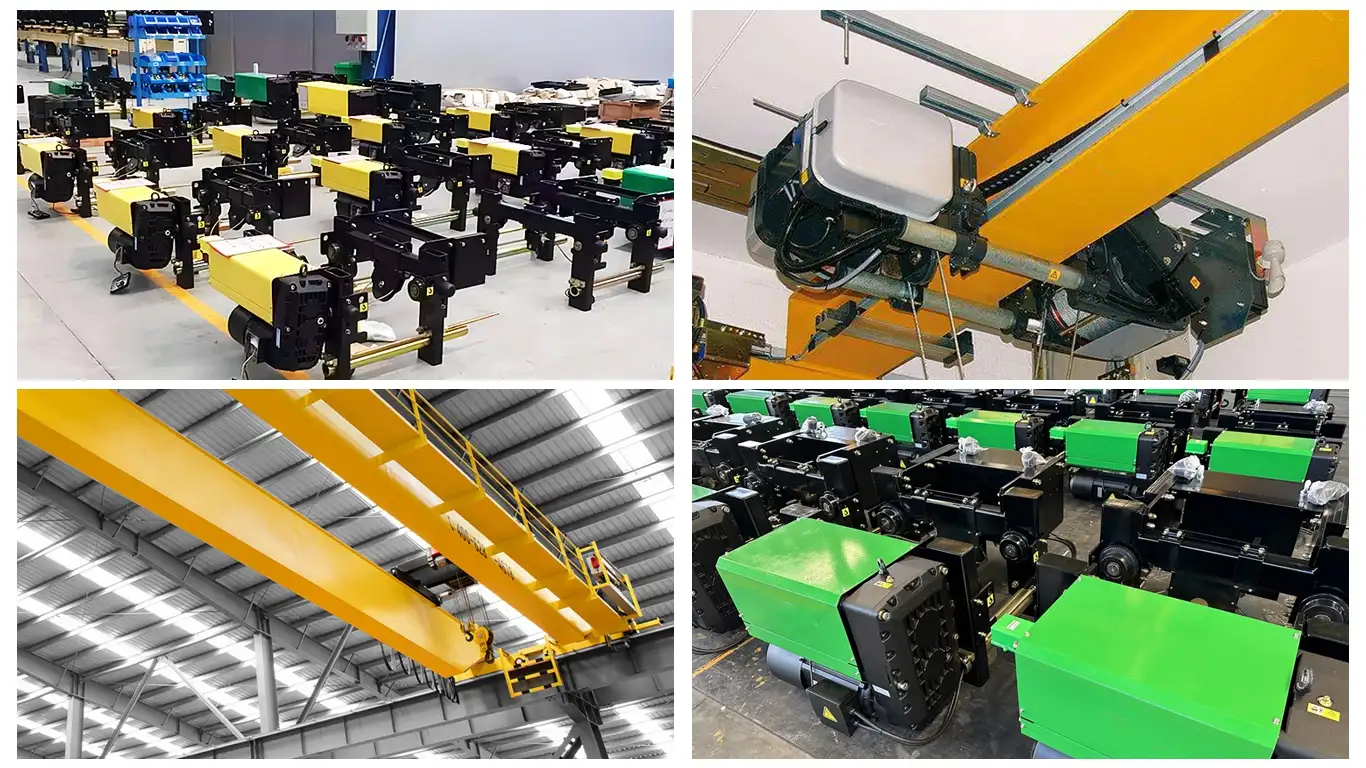
- Single-Girder Cranes (Underslung Monorail Trolley): The hoist travels along the lower flange of an I-beam or box girder. European-style low-headroom monorail hoists are preferred here to prevent loss of lifting height in tight manufacturing bays.
- Double-Girder Cranes (Top-Running Hoist Trolley / Crab Unit): The hoist mechanism is mounted on a four-wheel crab frame that rides along rails fixed on top of the dual bridge girders. This layout supports heavy capacities (10T to 100T+) and allows the hook to rise directly between the girders for maximum hook approach.
2. Sizing by Duty Classification: FEM 9.511 & ISO 4301 Standards
Underestimating the hoist operating duty cycle is the primary cause of contactor sticking and motor thermal tripping. Select your duty class based on average daily operating hours and state of loading:
| State of Loading | Daily Operating Time | FEM Duty Class | ISO Equivalent | Typical Workshop Application |
|---|---|---|---|---|
| Light (L1) | 2 – 4 hours/day | FEM 1Am | ISO M4 | Maintenance bays, toolrooms, light storage |
| Medium (L2) | 4 – 8 hours/day | FEM 2m | ISO M5 | Machining centers, general fabrication plants |
| Heavy (L3) | 8 – 16 hours/day | FEM 3m | ISO M6 | Foundries, precast concrete yards, steel coil processing |
| Very Heavy (L4) | Continuous (>16 hrs) | FEM 4m / 5m | ISO M7 / M8 | High-throughput steel mills, automated production lines |
3. Calculating Maximum Wheel Load on Crane Girders
The total static and dynamic wheel load ($P_{max}$) exerted by the hoist trolley onto the crane beam determines runway structural safety:
Maximum Static Wheel Load Formula:
$$P_{max} = rac{(W_{hoist} + W_{rated} imes psi)}{n_{wheels}} ext{ [kN]}$$
Where $W_{hoist}$ is deadweight of the trolley unit, $W_{rated}$ is maximum payload capacity, $psi$ is dynamic impact factor ($psi approx 1.15 ext{ to } 1.25$), and $n_{wheels}$ is total trolley wheel count.
4. Electrical & Safety Interlocks for Crane Integration
To ensure seamless integration with master crane bridge panels, GT Winch overhead hoists incorporate standard industrial controls:
- Inverter (VFD) Cross-Travel Motion: Programmable ramp-up and deceleration curves eliminate load pendulum sway during high-speed trolley transit (5–20 m/min).
- Dual Optical / Cross-Limit Sensors: Prevents hoist trolley over-travel against the end stops on the bridge girder.
- Wireless Radio Control Synchronization: Supports multi-motion master transmitters to control hoist lifting, trolley traverse, and bridge travel from a single ergonomic pendant.
Get Custom Crane Hoist Sizing & Wheel Load Calculations
Tell us your crane span, girder type (single or double beam), lift height, and rated capacity (1T to 100T). GT Winch engineers will deliver detailed dimensional drawings and quotation packages.
Engineering FAQ
Q1: Can I replace an old CD/MD wire rope hoist with a modern European hoist on the same crane beam?
A: Yes. Modern European low-headroom wire rope hoists feature adjustable trolley wheelbases that fit existing I-beam or H-beam flanges while providing lower overall weight and higher hook height.
Q2: When should I choose a chain hoist over a wire rope hoist on a single-girder crane?
A: For capacities between 0.5T and 5T where budget efficiency and compact footprint are priorities, an electric chain hoist with a motorized trolley offers an economical, reliable solution.
For complete crane modernizations, trolley retrofits, or technical quotes on wire rope hoists, contact GT Winch crane specialists.