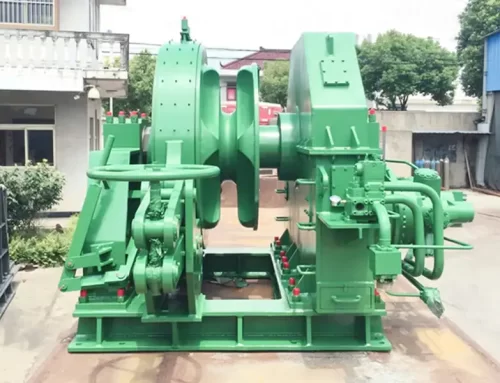
Selecting the correct marine winch is a mission-critical engineering decision for shipbuilders, offshore platform operators, and port authorities. Whether outfitting a commercial cargo vessel, tugboat, or offshore barge, an improperly sized marine winch risks operational downtime, equipment failure, and severe maritime safety hazards.
In this comprehensive technical guide, GT Winch Group’s marine engineering team breaks down the fundamental calculation methodologies for mooring and anchor winch sizing, brake holding load requirements, safety factors, and international classification society compliance (CCS, DNV, ABS, BV, LR).
1. Fundamental Forces in Marine Winch Sizing
Marine winches operate in harsh dynamic environments where dynamic sea states, tidal currents, and aerodynamic wind loads constantly act upon the vessel. Winch sizing centers around two primary load ratings:
- Rated Working Load (Line Pull): The maximum continuous pulling force the winch can deliver at the rated drum layer speed.
- Brake Holding Capacity (BHL): The static load the drum mechanical brake can hold without slipping (typically 80% to 100% of the mooring line’s Minimum Breaking Load).
2. Mooring Winch Sizing Calculations
According to OCIMF (Oil Companies International Marine Forum) guidelines and standard naval architectural practices, total environmental force acting on a berthed or moored vessel is calculated as:
Total Mooring Force ($F_{total}$) = $F_{wind} + F_{current} + F_{wave}$
- Wind Load ($F_{wind}$): $F_{wind} = 0.5 \times \rho_{air} \times V_{w}^2 \times C_w \times A_{trans}$
- Current Drag ($F_{current}$): $F_{current} = 0.5 \times \rho_{water} \times V_{c}^2 \times C_c \times A_{wetted}$
Where:
- $\rho_{air}$ & $\rho_{water}$ = Air and seawater density
- $V_w$ & $V_c$ = Maximum design wind speed (knots/m/s) and current velocity
- $C_w$ & $C_c$ = Aerodynamic wind drag and hydrodynamic current coefficients
- $A_{trans}$ & $A_{wetted}$ = Transverse windage area and wetted hull surface area
3. Anchor Windlass & Winch Pulling Requirements
For anchor handling and windlass systems, the required continuous pulling force ($Z_a$) must lift the total weight of the anchor plus the suspended chain in deep water:
$Z_a \ge 1.25 \times (G_{anchor} + L_{chain} \times w_{chain}) \times g \times (1 – \frac{\rho_{water}}{\rho_{steel}})$
Where buoyancy reduction in seawater ($\approx 87\%$ of dry weight) and hawse pipe / roller friction factors are rigorously incorporated.
4. Technical Comparison of Marine Winch Drive Types
| Drive Mechanism | Key Advantages | Typical Applications | Torque & Speed Control |
|---|---|---|---|
| Hydraulic Marine Winch | High torque density, stepless speed control, extreme reliability | Large commercial vessels, offshore tugs, heavy barges | Proportional hydraulic valves / HPU integration |
| Electric VFD Winch | Energy efficient, clean (no hydraulic leaks), low maintenance | Container ships, bulk carriers, coastal vessels | Variable Frequency Drive with dynamic braking |
| Diesel Driven Winch | Independent self-powered unit, ideal for remote/non-powered barges | Salvage operations, remote moorings, unpowered pontoons | Mechanical gearbox or integrated diesel-hydraulic |
5. Marine Classification Society Compliance (IACS)
To ensure seaworthiness and pass classification audits, all GT Winch marine models undergo rigorous non-destructive testing (NDT), weld inspections, and factory acceptance load testing under third-party witness (CCS, DNV, ABS, BV, RINA, LR).
Frequently Asked Questions (FAQ)
Q1: What is the recommended safety factor for marine mooring ropes?
A: Most classification societies mandate a minimum safety factor of 3.0 to 5.0 for mooring lines relative to the Maximum Working Load (MWL) under extreme survival conditions.
Q2: Can GT Winch customize multi-drum anchor and mooring combinations?
A: Yes. GT Winch supplies single, double, and waterfall-configuration multi-drum winch systems integrated with warping heads (capstans) and intelligent spooling gear.
For custom engineering consultations, vessel calculations, or certified drawings, contact GT Winch marine engineering team today or explore our full lineup of heavy-duty marine winches.