Construction and mining winch selection must match the load path, duty cycle, haul distance, shaft geometry, ventilation, and hazardous-area classification. Hydraulic and electric drives can both deliver high line pull, but their practical strengths differ in shaft sinking, long-distance hauling, cranes, tunneling, and heavy recovery operations.
Start with the Load Path
Define suspended load, rolling resistance, slope, rope mass, acceleration, reeving, drum layers, line speed, and brake holding load. The motor rating alone is not a safe capacity specification. Check the rope, drum, gearbox, brake, foundation, sheaves, and controls as one system.
Required line pull = rolling or suspended resistance + rope and sheave losses + acceleration allowance
Drum torque = line pull × effective radius ÷ transmission efficiency
Brake capacity must hold the maximum static load under the specified emergency condition
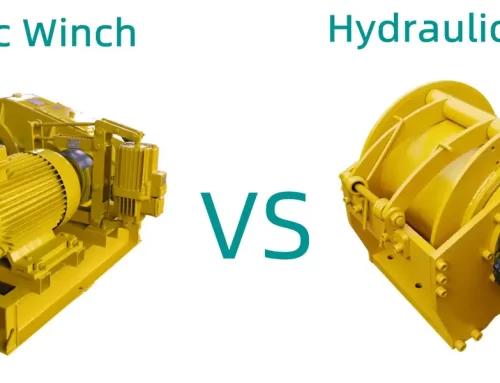
Hydraulic Drive for Construction and Mining
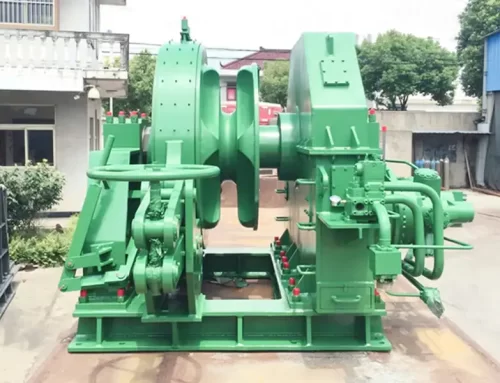
Hydraulic winches use a pump, motor, valves, hoses, and reservoir to produce high torque at low speed. They are a strong option for crawler cranes, drilling support, shaft sinking, tunneling, heavy recovery, and remote equipment where shock loads and compact motor packaging matter.
- High starting and stall torque with good overload tolerance.
- Fine low-speed control using proportional valves.
- Remote power-pack placement can simplify difficult installations.
- Requires filtration, cooling, hose protection, leak control, and scheduled oil service.
Electric Drive for Hauling and Fixed Installations
Electric winches combine a three-phase motor, gearbox, brake, VFD, and control system. They are effective for fixed mine haulage, long-distance cable pulling, construction hoists, material handling, and repetitive cycles where grid or generator power is dependable.
- Efficient operation and repeatable VFD speed control.
- Easy integration with PLCs, limit switches, load cells, and remote monitoring.
- Lower fluid-maintenance burden and clean indoor installation.
- Needs thermal protection, braking resistors or regenerative control, enclosure sealing, and correct stall management.
Shaft Sinking, Tunneling, and Long-Distance Hauling
For shaft sinking, calculate suspended weight, rope weight, conveyance acceleration, guide friction, and emergency braking. For long-distance hauling, calculate grade resistance, rolling resistance, rope sag, starts per hour, and allowable speed. Hydraulic systems are often favored for mobile and shock-loaded work; electric systems are often favored for fixed, high-utilization haulage with stable power.
ATEX and Mine Safety
Where methane, coal dust, solvents, or other flammable atmospheres may occur, do not assume a standard electric winch is suitable. Confirm the complete equipment certification and installation requirements for the classified zone. Options can include certified flameproof electric equipment or hydraulic/pneumatic power, but hoses, brakes, controls, grounding, and emergency isolation still require a documented risk assessment.
Engineering Selection Matrix
| Project condition | Hydraulic drive | Electric drive |
|---|---|---|
| Mobile crane or recovery | Excellent for compact packaging and shock loads | Suitable with protected generator and controls |
| Fixed mine haulage | Useful where HPU infrastructure exists | Efficient for high-utilization repetitive cycles |
| Shaft sinking | Strong low-speed torque and overload tolerance | Precise synchronized control and monitoring |
| Dust or hazardous zone | Can reduce electrical equipment at the machine | Requires correct certified enclosure and installation |
| Maintenance access | Inspect oil, filters, hoses, valves, and cooler | Inspect brake, bearings, insulation, VFD, and cables |
Project Decision Workflow
- Define load, line pull, holding load, speed, rope, drum capacity, and duty cycle.
- Calculate grade, rolling, suspended, friction, acceleration, and dynamic loads.
- Map the installation: mobile or fixed, available space, foundation, ventilation, and service access.
- Confirm hydraulic flow and pressure or three-phase voltage, starting current, generator margin, and braking method.
- Verify ATEX, IECEx, MSHA, local mine rules, guarding, emergency stops, and inspection records.
- Complete factory load testing, rope spooling checks, brake tests, commissioning, and operator training.
FAQs
Which drive is better for shaft sinking?
Both can work. Hydraulic drive is attractive for high starting torque and overload tolerance, while electric drive is attractive for synchronized control, monitoring, and fixed high-duty installations. The shaft load calculation and safety system determine the final choice.
Is hydraulic automatically safe in an ATEX zone?
No. Hydraulic power reduces electrical equipment at the machine but does not replace a full hazardous-area risk assessment. Controls, brakes, hoses, static discharge, and isolation must still satisfy the project rules.
Which system is more efficient for long-distance hauling?
Electric drives commonly offer strong efficiency for steady, repetitive haulage when power quality and braking infrastructure are adequate. Hydraulic may be preferable for mobile or highly variable duty.
What documents should be requested from a supplier?
Request calculations, GA and foundation drawings, rope and drum data, brake test results, motor or hydraulic curves, control schematics, certifications, inspection plans, manuals, and spare-parts lists.
For project-specific capacity calculations, review GT Winch industrial winch solutions or contact GT Winch engineering.